

What happened in the market this month? Find a detailed market and economic analysis of September 2026 here.
The Point
Monthly market update | September 2026 | Sherlock Wealth
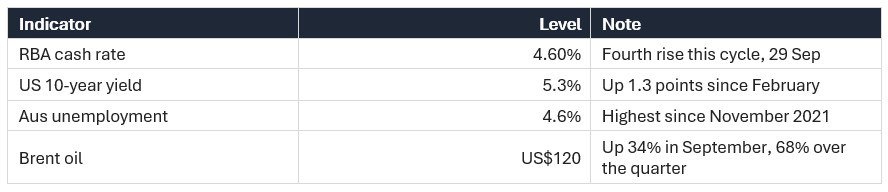
September capped a quarter that put inflation and the hiking cycle back at the centre of markets. The Fed and the RBA both raised rates, oil rose 68% over the quarter to US$120 a barrel as the Strait of Hormuz closed again, and bond yields rose around the world. Australian shares fell 2.4% for the month, while emerging markets rose on Asian technology.
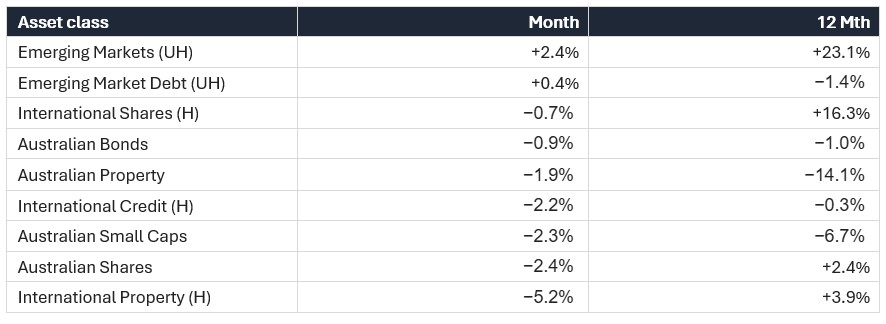
Source: LSEG Datastream, Bloomberg. Index returns in AUD; (H) hedged, (UH) unhedged. Past performance is not a reliable indicator of future performance.
What happened
Australia
Australian shares fell 2.4% in September as higher interest rates weighed on the market. Only healthcare (4.0%) and energy (1.2%) rose, while technology fell 9.8%. The market still rose 1.3% over the quarter, helped by a 25.6% gain in healthcare after CSL agreed to lower prices and expand US manufacturing.
The RBA raised the cash rate to 4.60% on 29 September, its fourth increase this cycle, and made clear inflation takes priority even if unemployment rises. Unemployment reached 4.6%, the highest since November 2021, largely because more people looked for work. Government bonds fell 0.9% and the Australian dollar 3.1%.
Housing is adjusting, not collapsing: prices fell 3.1% over the quarter and are about 5% below their peak, against our expected 10% to 15% decline. Insolvencies are concentrated in Bathla and Edge Early Learning, and bank arrears remain low.
Global
The Fed raised rates to 3.75–4.00%, its first increase since 2023, and upgraded its growth and inflation forecasts. The ECB also raised rates, while the Bank of England held at 3.75%. Stronger US business surveys pushed the US 10-year yield to 5.3%. Global government bonds fell 1.4% and credit fell 2.2%.
Hedged global shares fell 0.7% after gaining 17.1% over five months. Technology rose 4.5% on strong AI earnings, while materials fell 6.1%. Emerging markets gained 2.4%, led by Taiwan and Korea. Higher yields pushed listed property down 5.2% and infrastructure down 4.8%.
The US–Iran ceasefire collapsed and the Strait of Hormuz closed again. Brent rose 34% in September and 68% over the quarter to US$120. With US oil reserves depleted and Russian refineries damaged, diesel traded US$94 above crude. Energy led global sectors, rising 15.3% over the quarter.
How we see it
The AI investment boom has become large enough to change the price of money. AI investment is running at about 3.6% of US GDP, more than at the peak of the railroad boom, and the largest AI companies now compete with governments for the same long-term savings. The US 10-year yield reached 5.3%, and very little of the rise came from inflation expectations: investors are demanding a higher real return.
Energy adds a second source of pressure. The shock has moved from crude to diesel: refining capacity lost to war can take years to replace, and the Russian diesel deal covers only about an eighth of what the world has lost. Australia imports most of its fuel, so it feels this more than the US, and diesel reaches inflation through freight, farming and mining.
Higher real yields raise the hurdle for every investment, and long-duration assets reprice first: Australian listed property is down 14% over the year. We expect the investment cycle to keep supporting earnings, but against a higher hurdle and with a wider gap between winners and losers.
The Point: Scarce capital and higher diesel prices keep yields high. We stay invested with less interest-rate risk, and see Australian bonds, now yielding over 5%, as the place to add duration once yields peak.
Charts of the month
Australian diesel now costs 33c a litre more than petrol
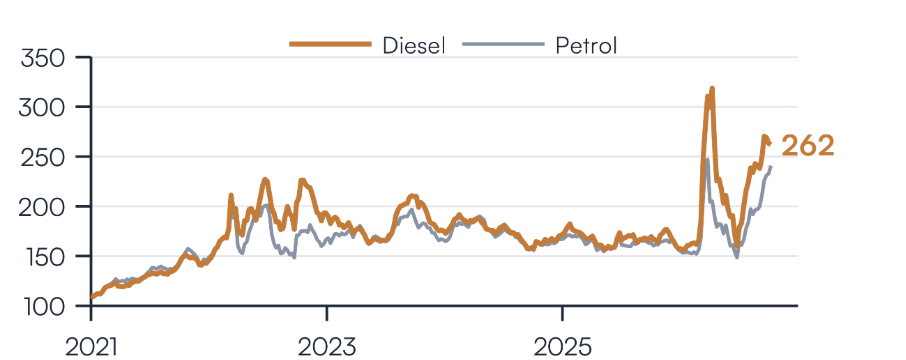
Source: Australian Institute of Petroleum, arcpoint. National wholesale price, c/L incl. GST, to 9 Oct 2026.
Ten-year bond yields have risen across the developed world
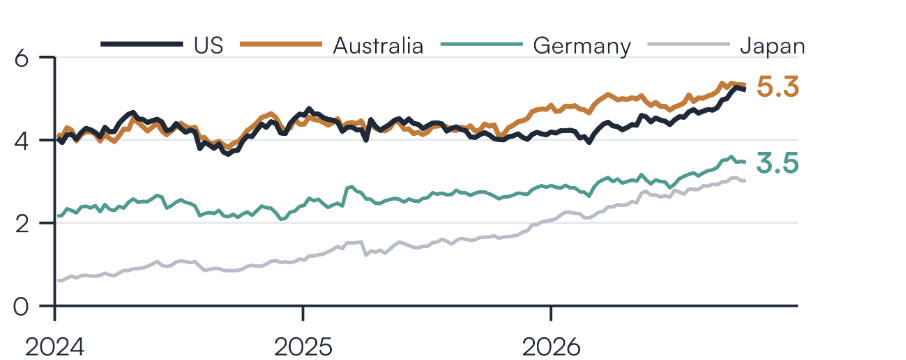
Source: Bloomberg, arcpoint. 10-year government bond yields, %. US 5.2%, UK 5.4%.
What we are watching
- Australian inflation (28 Oct). Is policy restrictive enough, or does the RBA need to tighten again? The September-quarter CPI and unemployment are the numbers to watch.
- US midterms (3 Nov). A divided Congress looks likely. Iran escalation, budget reconciliation and scrutiny of data centre construction could pressure equities.
- AI supply-chain earnings (October). Earnings guidance and order book visibility for companies in the AI supply chain.
- US 10-year yields. Higher long-term interest rates make future profits worth less today, so how high and how fast US yields rise will drive the prices of property, infrastructure and growth shares.

