
What happened in the market this month? Find a detailed market and economic analysis of August 2026 here.
The Monthly Market Update
August 2026
The ASX 300 rose 1.6% in August on healthcare and materials, up 18.1% and 12.4%; consumer discretionary fell 7.3%. Hedged international shares gained 2.5% while unhedged shares were up only 0.5%. Listed property and infrastructure came under pressure owing to their rate sensitivity and the rise in bond yields over the period.
Held again on 11 August
Up from 4.91%
Up to 7.6%; drove resources
Up 2.1%, cost 2pp
How asset classes performed
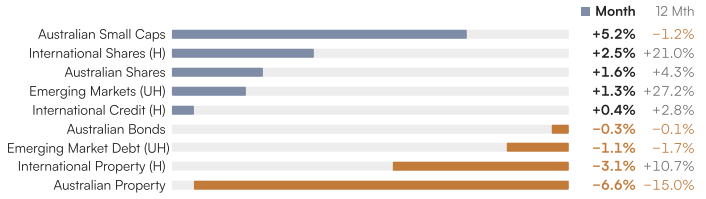
SOURCE: LSEG DATASTREAM, BLOOMBERG. INDEX RETURNS IN AUD; (H) HEDGED, (UH) UNHEDGED. PAST PERFORMANCE IS NOT A RELIABLE INDICATOR OF FUTURE PERFORMANCE.
What happened
Australia
Reporting season was mixed. Earnings growth improved as resources recovered, but revisions moved lower and guidance turned cautious. Power, grid, electrification, automation and data centre names reported full order books.
CSL led healthcare on evidence that its core plasma franchise had stabilised following a series of earnings downgrades.
CBA grew earnings per share 10.8%, helped by lower impairments, and still fell 2.2%; management pointed to softer household demand and a slowing economy. Household balance sheets are better placed than in 2019: ABS, Cotality and RBA securitisation data put under 4% of housing loans above 80% LVR against 13.5% then, with almost none in negative equity.
Unemployment rose to 4.5% and employment fell 15,800 in July. CPI rose 1.0%, above expectations, on transport as oil rose. The RBA held the cash rate at 4.35% and government bonds fell 0.3%.
Global
International shares rose 2.5% hedged and 0.5% unhedged, the Australian dollar taking the difference as it gained 2.1% on the US dollar. The S&P 500 rose 2.7% on reported US earnings up 52% y/y, led by technology. Materials and communication services led globally, up 9.1% and 6.3%, while utilities fell 3.5% as bond yields rose. Emerging markets rose 1.3% on Taiwanese and Korean technology.
Hormuz remained unresolved and new US tariffs added to trade uncertainty. Higher yields reached real assets: international listed property fell 3.1% and listed infrastructure 2.0%.
How we see it
The global economy has remained resilient. US growth rests on AI investment, re-shoring, infrastructure and domestic demand, and debt-servicing burdens remain manageable. Against that, real wages are pressured by increasing prices at the pump.
That leaves the Fed with a hard decision. Kevin Warsh has so far shown himself a reluctant hiker, preferring to look through a temporary energy shock, but with oil elevated and borrowing costs rising, the cost of inaction climbs too.
We do not read rising Treasury yields as a funding crisis. Heavy issuance, persistent inflation and a Fed allowing more price discovery have markets finding the clearing price for US government debt: volatile, but repricing rather than disorder.
For equities, earnings delivery matters more than further valuation expansion. We stay constructive on AI, infrastructure, electrification, automation and productivity investment: as the hurdle rate rises, companies converting capex into cash flow separate from those with only a narrative. What justifies the extraordinary AI build-out is falling compute costs, broadening adoption and a return on the spend. Company surveys show adoption still widening and the first corporate returns are appearing.
We remain cautious about Australia. Weak productivity, subdued demand, and no US-style large-scale capex boom argue for caution; low unemployment, healthy household balance sheets and public debt near 55% of GDP argue the other way.
Charts of the month
US PUMP PRICES ARE UP 51% THIS YEAR
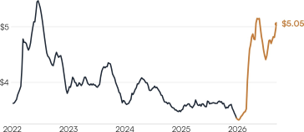
Source: Bloomberg AUTMUSAG, to 11 Sep 2026.
AI TOKEN PRICES HAVE HALVED SINCE MAY
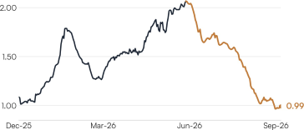
Source: Silicon Data LLM Token Index, Bloomberg
What we are watching
- The Fed’s response function. Whether it raises in September, and whether that holds inflation expectations and long-term yields without accelerating the slowdown in employment.
- Hormuz, oil and inflation. A resolution would relieve inflation, incomes and bond markets; further disruption raises the risk of stagflation and a firmer policy response.
- Australian employment. Jobs hold household resilience up. A sharper deterioration in employment, housing credit or spending would negatively impact company earnings.
Disclaimer
The information provided in this communication has been issued by Sherlock Wealth Advisory Pty Ltd (AFSL 558532).
The information provided is general advice only and has not considered your financial circumstances, needs or objectives. This publication should be viewed as an additional resource, not as your sole source of information. Where you are considering the acquisition, or possible acquisition, of a particular financial product, you should obtain a Product Disclosure for the relevant product before you make any decision to invest. Past performance does not necessarily indicate a financial product’s future performance. It is imperative that you seek advice from a registered professional financial adviser before making any investment decisions.
Whilst all care has been taken in the preparation of this material, no warranty is given in respect of the information provided and accordingly neither Sherlock Wealth Advisory Services Pty Ltd nor its related entities guarantee the data or content contained herein to be accurate, complete or timely nor will they have any liability for its use or distribution.